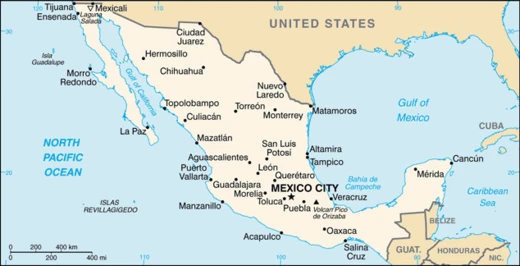
Chihuahua City
State capital of Chihuahua, Mexico; historic seat of Juárez's government.

Chihuahua City, the state capital of the Mexican state of Chihuahua, was founded on October 12, 1709, by Antonio Deza y Ulloa. It served as the de facto capital of Nueva Vizcaya for much of the 18th century and was briefly the capital of Mexico from 1864 to 1867 under President Benito Juárez during the Second French intervention. The city is a major industrial center and ranks highly in human development and urban competitiveness in Mexico.
- Founded
- October 12, 1709
- Population (2020)
- 925,762 (city); 988,065 (metro area)
- Country
- Mexico
- State
- Chihuahua
- HDI (2020)
- 0.842
- Known for
- Capital during French intervention; Pancho Villa's operations base; industrial h
Verified Timeline
Lore & Background
The city's name is older than the Spanish conquest, possibly from Nahuatl meaning 'between two waters' or from Rarámuri meaning 'dry and sandy place.' It was founded as El Real de Minas de San Francisco de Cuéllar at the intersection of the Chuviscar and Sacramento rivers, chosen for its location midway between the Rio Grande and the mining city of Hidalgo del Parral. During the colonial era, it became a meeting point for Roman Catholic missionaries heading to the Tarahumara region. During the Mexican–American War, Chihuahua fell to U.S. forces in 1847 after the Battle of the Sacramento. In the Mexican Revolution, it served as an operations base for Pancho Villa's División del Norte; his former estate, La Quinta Luz, is now the Historical Museum of the Mexican Revolution. The city experienced explosive growth under President Porfirio Díaz and became a center for banks and wealthy families.
Reader's Guide
Chihuahua City's significance lies in its role as a political and economic hub in northern Mexico. It was the seat of Benito Juárez's government-in-exile during the French intervention, symbolizing Mexican resistance. Its industrial base, including heavy and light industries and maquiladoras, drives the local economy, and the city is served by General Roberto Fierro Villalobos International Airport. The city's high human development index (0.842 in 2020) and ranking among Mexico's most competitive cities reflect its modern prosperity. Culturally, the International Festivals of Chihuahua, begun in 2005, showcase arts and music. The city's history as a mining and trade post, later transformed by foreign manufacturing in the 1970s, illustrates its adaptation to economic changes. Its legacy includes being the site of Miguel Hidalgo's imprisonment and execution in 1811, a key event in Mexico's independence struggle.
Did You Know?
- The city was named capital of Mexico for a brief amount of time in 1864 by Benito Juarez during the Second French intervention in Mexico.
- Miguel Hidalgo, considered the Father of the Country, was imprisoned and executed in 1811 at the same building—the then-Government Palace (now the Palacio de Gobierno)—by the Spaniards.
- During the Mexican–American War, Chihuahua fell to U.S. forces in 1847 after the Mexican Army was defeated at the Battle of the Sacramento, 15 miles (24 km) north of the city.
- The city's name is older than the Spanish conquest of Mexico, possibly from Nahuatl meaning 'between two waters' or from Rarámuri meaning 'dry and sandy place.'
- In the 1990s the city grew dramatically economically, becoming the third wealthiest municipality (per capita) in the republic, after Benito Juárez borough of the Federal District (Mexico City), and San Pedro Garza García
Origins & Naming
The story of Chihuahua City begins long before Spanish boots touched its soil. The name itself predates the conquest, carrying echoes of Nahuatl ("between two waters" or "place of the holed-rock") and Rarámuri ("dry and sandy place"), a testament to the indigenous peoples who knew this land first. On October 12, 1709, Spanish explorers Blas Cano de los Ríos and Antonio Deza y Ulloa formally established the settlement as El Real de Minas de San Francisco de Cuéllar, with land generously donated by Don Ildefonso de Irigoyen. The site was no accident: it sat at the confluence of the Chuviscar and Sacramento rivers and occupied a strategic midpoint between the Río Bravo del Norte and the mining town of Hidalgo del Parral. By 1718, the community had earned Villa status under the longer name San Felipe el Real de Chihuahua, before the name was finally trimmed to its familiar form in 1823. For much of the eighteenth century, it functioned as the de facto capital of Nueva Vizcaya, as governors preferred its location over the official seat in Durango.
A Stage for Mexico's Turbulent History
Chihuahua City has repeatedly found itself at the crossroads of national upheaval. In 1811, the Federal Palace became the grim holding cell for Miguel Hidalgo, the Father of the Country, who was executed nearby at the Government Palace by Spanish authorities. Decades later, during the Mexican–American War, U.S. forces captured the city in 1847 following the Mexican Army's defeat at the Battle of the Sacramento, just 24 kilometers to the north. Perhaps the most dramatic chapter came in 1864, when President Benito Juárez, fleeing the Second French Intervention, designated Chihuahua as the seat of his government-in-exile until 1867. Under Porfirio Díaz, the city experienced explosive growth, attracting banks and wealthy families. The Mexican Revolution brought Pancho Villa's División del Norte to use the city as an operations base, and his former estate, La Quinta Luz, was converted into a museum by his widow, María Luz Corral de Villa, and is now managed by the federal government.
From Trade Post to Industrial Powerhouse
For most of its early history, Chihuahua City functioned as a modest trade hub for cattle and agricultural products, its economy tethered to the rhythms of the northern ranchlands. That changed in the 1970s when foreign manufacturing plants began to take root, shifting the city toward a predominantly industrial economy encompassing heavy and light manufacturing, consumer goods production, and a smaller maquiladora sector. The 1990s brought dramatic economic acceleration, elevating Chihuahua to the third-wealthiest municipality per capita in the entire republic, trailing only Benito Juárez borough in Mexico City and San Pedro Garza García in Nuevo León. The early 2000s saw commercial modernization accelerate: Plaza del Sol opened as the city's first large shopping mall, and the commercial Zone of the Sun sprouted along the Periférico de la Juventud, one of the city's principal thoroughfares.
Modern Governance & Cultural Identity
In the twenty-first century, Chihuahua City has cultivated a reputation for both political dynamism and cultural vibrancy. A 2020 UNDP report placed the municipality's Human Development Index at 0.842, ranking it among the highest in Mexico behind only the Monterrey and Mexico City areas, while IMCO identified it as one of six cities with very high urban competitiveness. Politically, the city has seen a rotation of mayors across parties—PRI and PAN—reflecting genuine electoral competition, as in the razor-thin 2007 mayoral race decided by less than a quarter of a percentage point. Culturally, the International Festivals of Chihuahua, held each September and October since 2005, have brought world-class performances to venues across the city, with acts ranging from Los Lobos to Creedence and Foreigner. The city's Lipan name, Ją'éłąyá, alongside its Spanish identity, reminds residents that Chihuahua's story is layered, multilingual, and still unfolding.
Frequently Asked Questions
Who is Chihuahua City?
Chihuahua City is the state capital of Chihuahua in northern Mexico, laid out in 1709 by the colonial official Antonio Deza y Ulloa. It has since grown into one of the country's most economically dynamic urban centers in the high desert.
What is Chihuahua City's role in the national story?
For much of the 1700s it functioned as the practical capital of the colonial province of Nueva Vizcaya, and from 1864 to 1867 it sheltered the government of President Benito Juárez while French-backed imperial forces occupied the rest of the country.
How does Chihuahua City's arc resolve?
In the present day the city has settled into the role of a major manufacturing and logistics hub, consistently posting among the highest human-development and urban-competitiveness scores in all of Mexico.
Why does Chihuahua City matter to the broader canon?
Beyond hosting Juárez's government-in-exile during the Second French Intervention, the city served as a key operational base for Pancho Villa's forces during the Revolution, cementing its place in the narrative of how modern Mexico was forged.
What are Chihuahua City's core stats?
The 2020 census counted roughly 926,000 residents in the city proper and about 988,000 across the metro area, with a human-development index of 0.842.
More in Mexican Cities 1-20
Spotted an error? Know more?
This is a living reference — every entry is fact-audited, and reader corrections feed straight into our audit queue. Suggest an edit · See this site's audit record