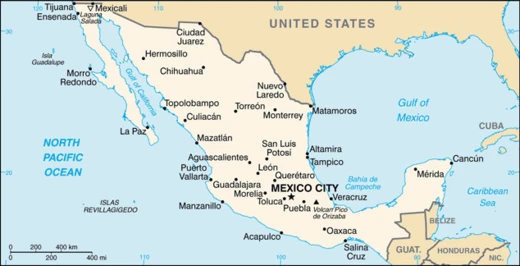
Ecatepec de Morelos
Third most-populous municipality in Mexico, northern suburb of Mexico City.

Ecatepec de Morelos is a municipality in the State of Mexico, located north of the Greater Mexico City urban area. The name 'Ecatepec' derives from Nahuatl, meaning 'windy hill' or 'hill devoted to Ehecatl' (the wind god), and 'Morelos' honors José María Morelos, a hero of the Mexican War of Independence.
- Municipal seat
- San Cristóbal Ecatepec
- Country
- Mexico
- State
- State of Mexico
- Patron saint
- Saint Christopher (celebrated July 25)
- Köppen climate
- Cwb (oceanic/subtropical highland)
Lore & Background
Notable tlatoque included Chimalpilli I, grandson of Moctezuma I; Tezozomoc, son of Chimalpopoca; Matlaccohuatl, whose daughter Teotlalco married Moctezuma II; Chimalpilli II, son of Ahuitzotl; and Diego de Alvarado Huanitzin, grandson of Axayacatl, who later became tlatoani of Tenochtitlan. During the Aztec empire, the Mexicas used the town to control trade routes going north.
Reader's Guide
Ecatepec de Morelos is significant as a densely populated industrial and commercial hub within the Greater Mexico City area. Its economy is built on manufacturing, commerce, and services, with major shopping centers including Multiplaza Aragón, Mexico's busiest shopping center as of 2018, and Plaza Las Américas. The municipality is served by the Mexico City metro, Mexibús bus rapid transit, and Mexicable aerial cable cars.
Did You Know?
- The name 'Ecatepec' means 'windy hill' or 'hill devoted to Ehecatl' (the wind god) in Nahuatl.
- Ecatepec is the most-populous suburb of Greater Mexico City and the third most-populous municipality in Mexico.
- The remains of Aztec tlatoque of Ecatepec include Chimalpilli I, grandson of Moctezuma I, and Diego de Alvarado Huanitzin, grandson of Axayacatl.
Aztec Roots and Pre-Columbian Governance
The land that would become Ecatepec carries layers of pre-Hispanic history stretching back to the earliest human settlements discovered on Cerro de Ecatepec. Successive waves of Otomi peoples first inhabited the region before Toltec-Chichimeca groups arrived and reshaped the cultural landscape of the Valley of Mexico. Eventually, the area fell under Aztec imperial control and was organized as an altepetl, a self-governing city-state. Notable rulers included Chimalpilli I, grandson of Moctezuma I, and Matlaccohuatl, whose daughter Teotlalco became the wife of Moctezuma II. The Mexicas also valued the town strategically, using it as a checkpoint to regulate trade routes heading northward. This deep dynastic connection to the imperial capital gave the settlement a prestige and political significance that extended well beyond its modest size in the valley.
The Martyrdom of Morelos and Colonial Legacy
That autonomy was curtailed in the early 1600s when the Spanish replaced the indigenous leadership with a mayorship system. The very house where he met his end now houses the Museo Casa de Morelos, a permanent reminder of sacrifice.
Explosive Growth and Modern Infrastructure
Beginning in the 1970s, Ecatepec underwent a dramatic demographic transformation as rural populations streamed into the Valley of Mexico in search of opportunity. Growth has since plateaued, but the infrastructure built to serve that density remains among the highest in the State of Mexico. The city is threaded by the Mexico City metro, the Mexibús bus rapid transit network, and the Mexicable aerial cable car system. Economically, Ecatepec functions as a major industrial hub where manufacturing, commerce, and services dominate; Jumex maintains its corporate headquarters here. The Vía Morelos corridor links the city to industrial zones housing factories for Jumex, La Costeña, and Agromit, while also serving as a critical arterial route connecting Mexico City to states like Hidalgo.
Faith, Identity, and Living Heritage
The very name Ecatepec is a Nahuatl evocation of the wind god Ehecatl, an alternate name for Quetzalcoatl, translating to windy hill or hill devoted to Ehecatl. This spiritual resonance persists in the city's Catholic identity: Saint Christopher serves as patron saint, honored each July 25. The Catedral del Sagrado Corazón de Jesús anchors the religious landscape, surrounded by several colonial-era churches and the Morelos Museum housed in the Casa de los Virreyes. The area's natural heritage also endures in the Sierra de Guadalupe, where oyamel pines, oaks, ocote pines, century plants, and prickly pears shelter small mammals like gray squirrels and gophers, along with birds such as cenzontles and sparrows.
Frequently Asked Questions
What is Ecatepec de Morelos?
Ecatepec de Morelos is a municipality in the State of Mexico that sits just north of the Greater Mexico City metro area. It currently ranks as the third most-populous municipality in all of Mexico, with San Cristóbal Ecatepec serving as its municipal seat.
Where does the name Ecatepec de Morelos come from?
The word 'Ecatepec' is Nahuatl for 'windy hill' or 'hill dedicated to Ehecatl,' the pre-Hispanic wind deity. The 'de Morelos' portion was added as a tribute to José María Morelos, a central figure in Mexico's independence struggle against Spain.
What is the climate like in Ecatepec de Morelos?
The municipality falls under the Cwb Köppen classification, meaning it has an oceanic or subtropical highland climate. In everyday terms, residents see mild, relatively stable temperatures year-round with a clear distinction between a wet season and a dry season rather than extreme heat or cold.
Who is the patron saint of Ecatepec de Morelos and when is it celebrated?
Saint Christopher is the municipality's patron saint, and his feast day is observed on July 25 every year. Local parishes and neighborhoods typically mark the date with processions, masses, and community gatherings.
Why is Ecatepec de Morelos important in the Mexican urban landscape?
As the third most-populous municipality in Mexico and a key northern suburb within the Greater Mexico City conurbation, it is a major hub for housing, light industry, and daily commuter traffic. Its sheer size and closeness to the capital make it one of the most economically active suburban centers in the country.
More in Mexican Cities 1-20
Spotted an error? Know more?
This is a living reference — every entry is fact-audited, and reader corrections feed straight into our audit queue. Suggest an edit · See this site's audit record